Kraków · City guides
Three Days in Kraków as a Solo Traveler (2026)
 Bartu Bozkurt · 7 min read
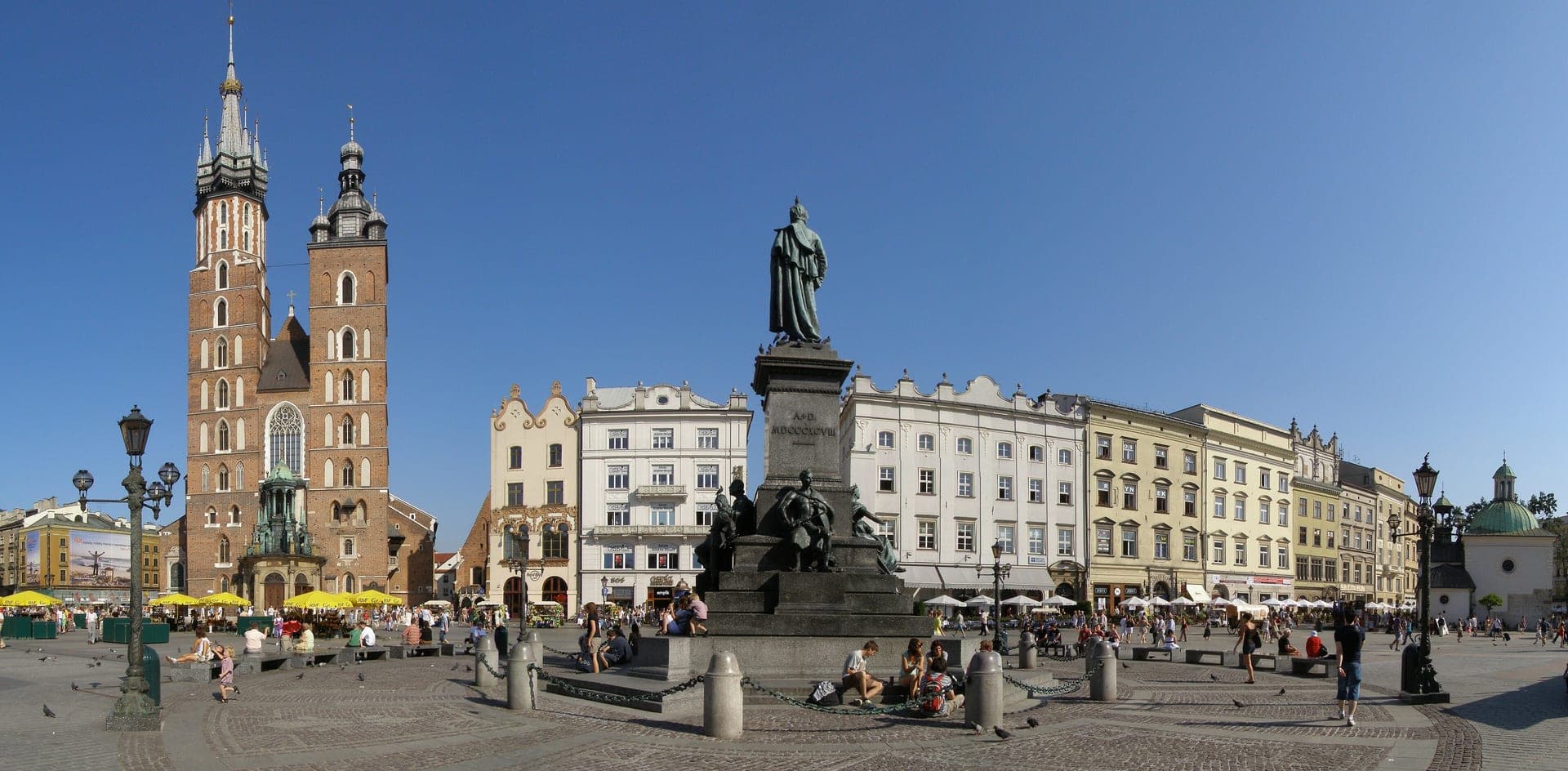
Photo: Wikimedia Commons
Quick answer: Three days in Kraków works well alone: one day for the Old Town, Wawel and Kazimierz, one for Auschwitz-Birkenau, one for Wieliczka Salt Mine and Podgórze. Book Auschwitz first. Passes are online only, and free ones close seven days before your visit and only allow late-day entry, so a guided morning tour is usually simpler.
Most itineraries slot Auschwitz between the salt mine and the pierogi. It deserves better. It is the site of a genocide, and it is also a logistics problem whose rules changed in 2026, so plan the visit properly and plan the hours after it too.
What are the best things to do in Kraków as a solo traveler?
The best things to do in Kraków alone are the ones you can do at your own speed: the Old Town and Wawel Hill on foot, then an evening in Kazimierz. That's day one, and it needs almost no booking.
Old Town and Wawel
Most of it sits inside the Planty, the ring of park that circles the Old Town. Start in the Main Market Square, with the Cloth Hall in the middle and St Mary's Basilica on the corner. Be there on the hour for the hejnał, a trumpet call played live from the taller tower. It breaks off mid-tune. Everyone stands looking up at the same window, which makes it a very easy place to be alone.
Then walk south to Wawel Hill. The grounds cost nothing to wander. The castle's exhibitions and the cathedral are ticketed separately and run by different organisations, so pick one or two. Hours shift with the season, so check bilety.wawel.krakow.pl, the castle's official ticket site, before you go. Our Kraków solo travel guide has more daytime ideas, and the Kraków city page has the basics.
An evening in Kazimierz
Kazimierz was the centre of Jewish life in Kraków for centuries, so walk it in the last of the daylight before it turns into a night out. Szeroka Street holds the Old Synagogue and the Remuh Synagogue with its cemetery.
Then head to Plac Nowy, where the round market building, the Okrąglak, sells zapiekanki. A zapiekanka is a long open baguette under mushrooms and cheese, eaten standing up, which solves dinner for one by itself. For a sit-down meal, our guide to eating dinner alone has the tricks. Afterwards, Alchemia on the same square is a candlelit bar, going since 1999. Check it's open before you make a special trip.
How do you book Auschwitz-Birkenau on your own?
Book a named entry pass at visit.auschwitz.org, the only official channel, because nothing has been sold at the entrance since March 2026. Entry to the grounds is free, but alone we'd pay for the guided tour with an educator.
| Compare | Guided tour with educator | Free pass, no educator |
|---|---|---|
| Cost | Paid, fee on booking site | Free |
| Booking | Online, until sold out | Online, at least 7 days ahead |
| Entry | From 7:30am | Late in the day only |
| Time on site | About 3.5 hours | 2.5 hours at most, 3.5 in June to August |
| Between the camps | Museum provides transport | Check when you book |
Under the museum's regulations in force since July 2026, entry before a set hour is with an educator only, with a few exceptions. That hour is 5pm from April to September, 4pm in March and October, 3pm in February, 2pm in November and January, and 1pm in December. The museum's visiting page suggests about 90 minutes for each of the two camps, so outside summer you'd be rushing. Rules have changed more than once recently, so check before you go.
Audio guides and apps are banned across the site, so a tour is the only way to get commentary. The museum advises reserving guides at least two months ahead. Individual passes can't be changed or refunded, so settle your date first, and carry ID, because the pass is in your name.
How do you get from Kraków to Auschwitz?
Take a bus from the MDA station next to Kraków Główny, about an hour and a half each way, or a train to Oświęcim, whose station is about 1.5km from the main entrance.
Check that day's timetable in both directions and leave a margin, since you need to arrive at least 30 minutes before a tour for security. If you hold a free pass, check the last service back before you book it. Bags can't exceed 35 x 25 x 15 cm and storage is paid, so leave your backpack in Kraków.
What should you expect at Auschwitz-Birkenau?
Expect a long, mostly outdoor day at the place where Nazi Germany murdered at least 1.1 million people, about a million of them Jews, along with Poles, Roma, Soviet prisoners of war and others.
The visit starts at Auschwitz I, with brick blocks and exhibitions that include belongings and human hair taken from victims. Birkenau is different: enormous, exposed and mostly empty, with the railway tracks running into it and the ruins of the gas chambers at the far end. The ground is uneven, so dress for the weather and for the place. Our Kraków climate guide shows what a given month is like.
The rules are few. No eating on the grounds, no phone calls inside the buildings, no flash or tripods. Photography is forbidden in Block 4, Room 5 and in the basement of Block 11, and the museum has asked people not to pose on the tracks.
You may feel a lot, or very little. Neither means you did it wrong.
Who should skip it: anyone going because it's on a list. Nothing about Kraków requires this visit, and it's fine to leave it out. The museum doesn't recommend it for children under 14. If you do go, make it the middle day, with a day either side.
What should you do the evening after visiting Auschwitz?
Keep it small, and decide that before you leave in the morning. Eat something plain, walk somewhere ordinary, and don't book anything that needs you to be good company.
- Eat, even without much appetite. A bar mleczny, or milk bar, is a cheap Polish canteen, and soup and pierogi there are the right scale. Many close early, so check.
- Walk before you go inside. A stretch of the Planty puts you among joggers and dog walkers, an ordinary evening going on around you.
- Call someone, or write down what you saw while it's clear. Going alone means nobody on the ride back shared the day with you.
- Skip the pub crawl. It'll still be there tomorrow.
Wieliczka or Podgórze: which is the lighter day?
Wieliczka is the lighter one, and it fills your morning. Podgórze is lovely for an afternoon walk, but it held the wartime ghetto, so parts of it are not light at all.
Wieliczka Salt Mine is the right kind of strange for today. The SKA1 train from Kraków Główny takes about 25 minutes to Wieliczka Rynek-Kopalnia, and the Daniłowicz shaft is a five-minute walk from there. The official route is about 3.5km and two to three hours, with around 800 stairs, 380 of them at the start, and it's 17 to 18°C underground. A guide is compulsory, so you're automatically in a group looking at a chapel carved out of salt. A lift brings you back up. Buy online.
Back in the city, cross the Father Bernatek footbridge from Kazimierz into Podgórze and climb Krakus Mound, an ancient earth mound with a panorama of the city. Ghetto Heroes Square is a memorial of 70 empty chairs, and Oskar Schindler's Enamel Factory, a branch of the Museum of Kraków, tells the story of the occupation. Both are worth your time, but after yesterday you may want to skip them, and nobody is checking. The factory shuts on the first Tuesday of the month and some other dates, so check its site. Then walk back over the bridge for a last night in Kazimierz.
Is Kraków safe for solo travelers?
Yes. Kraków is safe to walk alone, including at night in the Old Town and Kazimierz, and violent crime against visitors is rare. The real risk is to your wallet.
- The Old Town bar scam. A friendly stranger or a promoter invites you to a particular club or bar, and the bill arrives wildly inflated. Strip clubs are the classic setting, and Polish media have reported serious cases. Choose your own venue, check prices before ordering, and don't follow anyone anywhere.
- Taxis. Use Bolt or Uber rather than an unlicensed driver at the station.
- Pickpockets work crowded trams and markets, so keep your phone out of your back pocket.
If you meet anyone from an app, our safety checklist covers the details.
How do you meet people in Kraków?
Join something with a group built in: an Old Town walking tour by day, a hostel bar or a Kazimierz counter at night. Our guide to meeting people when you travel alone has more.
Or use Suppertime, a map of small plans other travelers have posted for today. The kind of thing that suits Kraków: a zapiekanka on Plac Nowy, a drink at Alchemia, sunset on Krakus Mound, the salt mine in the morning. Join one, or post your own and see who comes. Each plan has its own group chat that disappears afterwards, there are no DMs, links are blocked in chats, and plans can be women-only or LGBTQ+ friendly. It's free on iOS.
Frequently asked questions
Can you visit Auschwitz without a guide?
Yes. Free passes for visiting without an educator are available online if you book at least seven days ahead, but entry is only allowed late in the day, from 1pm in December to 5pm from April to September. Audio guides and apps are not allowed on site.
Can you buy Auschwitz tickets on the day?
No. Since March 2026 entry passes are not sold at the entrance. Every pass is booked online at visit.auschwitz.org, and guided tours can be booked until they sell out.
How long does a day trip from Kraków to Auschwitz take?
Plan on most of a day. The standard guided tour lasts about three and a half hours, the bus takes about an hour and a half each way, and you should arrive at least 30 minutes before your tour.
How long do you need for Wieliczka Salt Mine?
The tourist route takes two to three hours, and the SKA1 train from Kraków Główny takes about 25 minutes. A morning is enough, and you can be back in the city for the afternoon.
Is three days enough for Kraków alone?
Yes. Three days covers the Old Town, Wawel, Kazimierz and both major day trips at a sensible pace. With only two days, choose either Auschwitz or Wieliczka rather than rushing both.